ISO 14067 explained: An easy to understand guide to the international PCF standard
By Glassdome Admin
Customers, regulators, and investors are demanding one thing with increasing urgency: full transparency about the greenhouse gas emissions embedded in every product you ship. ISO 14067 is the international standard that defines exactly how to measure, quantify, and communicate the Product Carbon Footprint (PCF) in a way that meets the highest standards of data accuracy and regulatory compliance.
What is ISO 14067?
ISO 14067 is an international standard published by the International Organization for Standardization (ISO) that specifies principles, requirements, and guidelines for the quantification and carbon footprint reporting of products (CFP). It is part of the broader ISO 14000 family of environmental management standards, which together form the backbone of corporate environmental responsibility.
First published in 2013 and updated in 2018, the standard draws on the methodology of Life Cycle Assessment (LCA) as defined in ISO 14040 and ISO 14044. In practical terms, it provides a scientifically rigorous and internationally recognized rulebook for answering one deceptively simple question:
How much CO₂ emissions and other greenhouse gases are associated with making, using, and disposing of this product?
Why ISO 14067 Is Gaining Urgency in 2026
Three forces are converging to make PCF compliance a strategic priority and a prerequisite for climate action, rather than an optional sustainability gesture:
- Regulatory compliance pressure. Regulations such as the Corporate Sustainability Reporting Directive (CSRD) require verifiable, standardized carbon footprint data at the product level. Non-compliance is no longer a reputational risk, it is a financial and legal one.
- Supply chain requirements. OEMs and Tier 1 suppliers are increasingly mandating ISO 14067-aligned PCF data from their supply chains as a condition of contract. Transparency at every tier is becoming the price of entry, not a differentiator.
- Investor scrutiny and sustainability goals. ESG-aligned investors use PCF data to benchmark decarbonization progress against stated sustainability goals. Companies without it face higher cost of capital and exclusion from sustainability-linked financing instruments.
The Product Lifecycle Under ISO 14067
The central methodological concept in ISO 14067 is the product lifecycle perspective — the idea that emissions measurement must trace CO₂ emissions and other greenhouse gas emissions across the entire value chain of a product, not just within the walls of the final assembly plant. The standard defines five core lifecycle stages:
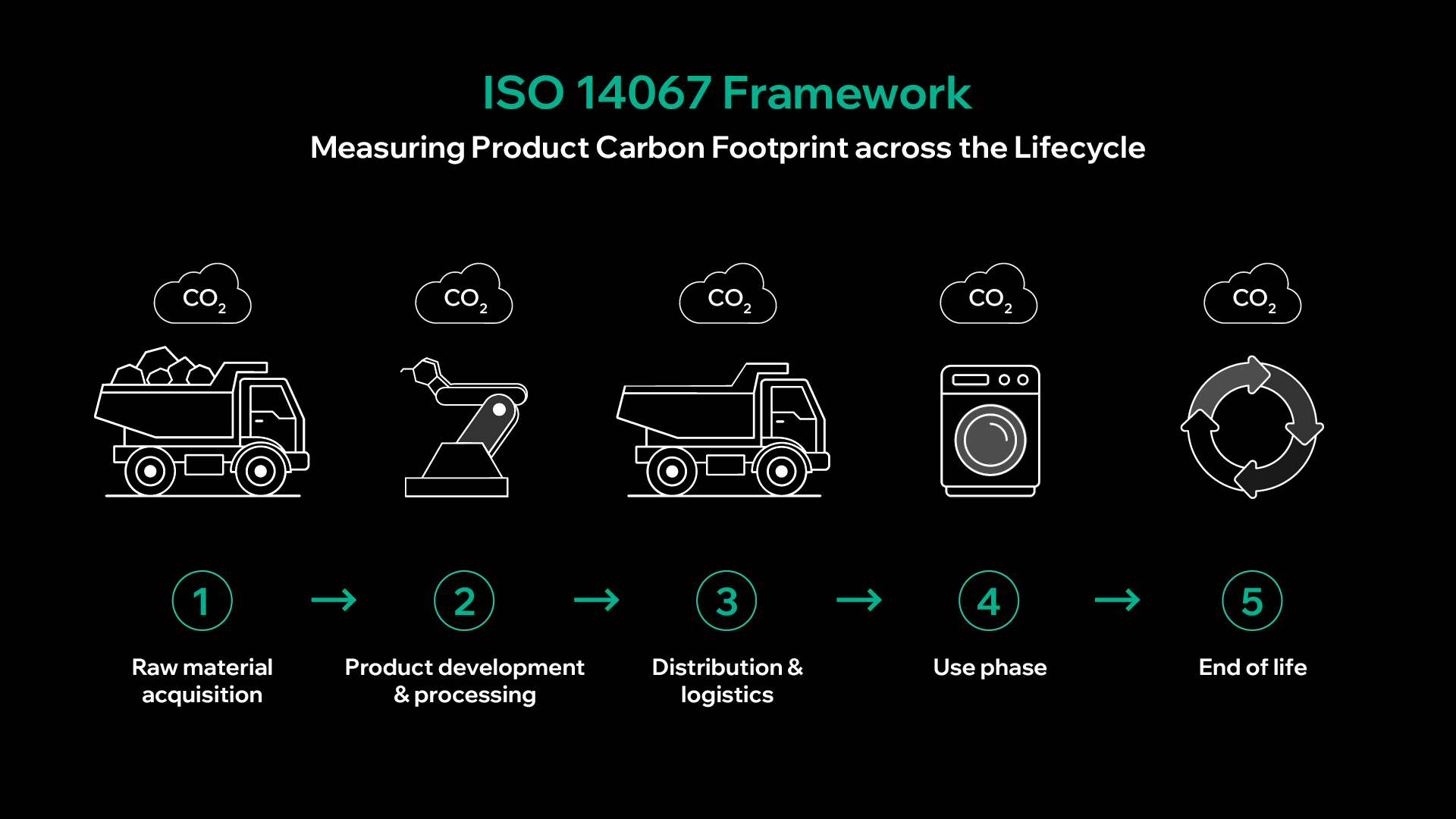
Figure 1: ISO 14067 lifecycle framework showing the five stages of product carbon footprint measurement from raw material acquisition to end of life
Raw material acquisition (the extraction and processing of ores, polymers, and other inputs) is typically the largest contributor to the PCF in steel and battery production. Product development and upstream processing stages are where engineering decisions made early in the value chain have the greatest leverage on emission reduction later. Understanding which lifecycle stages contribute most to total CO₂ emissions is therefore as important as the final number itself.
These lifecycle stages translate into well-defined system boundaries for the PCF study:
01 Cradle to gate
From raw material acquisition to the factory gate. Most common in B2B supply chain contexts where downstream use varies.
02 Cradle to grave
Full product lifecycle including use phase and end-of-life treatment. Required where downstream use is known and material.
03 Gate to gate
A single processing stage in isolation. Useful internally but insufficient for external carbon footprint reporting under ISO 14067.
Step by Step: Emissions Measurement Under ISO 14067
- Define goal and scope. Specify the product, functional unit, system boundary, and intended audience of the PCF study. Precision at this stage determines the quality of emissions measurement throughout.
- Compile the Life Cycle Inventory (LCI). Collect quantitative carbon footprint data on all inputs (energy, materials, water) and outputs (CO₂ emissions, waste, other greenhouse gas emissions) at each lifecycle stage. Data accuracy here is non-negotiable, as it determines the credibility of the entire PCF. Supply chain data collection is consistently the hardest bottleneck.
- Apply Life Cycle Impact Assessment (LCIA). Convert all greenhouse gas emissions into CO₂ equivalents using characterization factors from IPCC assessment reports. The standard mandates a 100-year global warming potential horizon for consistency and comparability.
- Handle allocation. When a process produces multiple outputs, greenhouse gas emissions must be allocated between products. ISO 14067 specifies a preference hierarchy: avoid allocation, then use physical causality, then economic value.
- Account for biogenic carbon and removals. The standard has specific rules for carbon stored in bio-based materials and for carbon removal activities, both must be reported separately from fossil-based CO₂ emissions to preserve transparency.
- Communicate results for carbon footprint reporting. Results are expressed in kg CO₂e per declared unit. ISO 14067 distinguishes between a full PCF study and a partial PCF, each with different disclosure requirements for carbon footprint reporting to customers, regulators, and auditors.
Find out more about our ISO 14067 verified Product Carbon Footprint solution
What ISO 14067 Means for Your Industry
Automotive OEMs & Tier 1 suppliers
PCF data is becoming a standard field in supplier RFQs. OEMs building CSRD compliance cases need cradle-to-gate carbon footprint data from every major supply chain tier. ISO 14067 provides the common methodology. Companies lacking carbon footprint reporting capability are already losing tenders and the gap will widen as sustainability goals harden into contractual obligations.
Chemical manufacturers
The chemical industry is one of the most advanced sectors in ISO 14067 adoption, driven by the Together for Sustainability (TfS) initiative. TfS, a consortium of over 40 major chemical companies including BASF, Dow, and Evonik, has published PCF Guidelines (currently version 3.0) that are explicitly built on full ISO 14067 and GHG Protocol compliance. Downstream customers in automotive, electronics, and construction increasingly require ISO 14067-compliant PCF data from their chemical suppliers. Companies that cannot deliver harmonized, TfS-aligned PCF data risk being excluded from supply chains where carbon transparency is now a procurement condition.
Semiconductors manufacturers
Major electronics brands and cloud infrastructure providers are increasingly requiring cradle-to-gate PCF data from their chip suppliers as a condition of procurement. The Semiconductor Climate Consortium (SCC), with over 60 member companies under SEMI, is developing a sector-wide PCF methodology targeting 2028. ISO 14067 provides the methodological foundation for addressing the sector’s distinctive challenges: high energy intensity, hundreds of specialty chemicals, and complex multi-product allocation across fab lines. Companies that build ISO 14067-aligned PCF capability now will be well positioned as the SCC framework matures and customer data requests scale.
Audit and Verification
One of the most consequential decisions in any PCF program is whether and when to seek external audit and certification. ISO 14067 itself does not mandate third-party verification, but the commercial and regulatory environments in which PCFs are used almost universally do.
Third-party verification validates data accuracy, provides transparency to downstream customers and supply chain partners, and strengthens the credibility of PCF claims in commercial and procurement contexts. A PCF that has not been through audit and certification is increasingly treated as unverified carbon footprint data and therefore discounted or rejected in commercial negotiations.
For companies in industrial sectors, the most pragmatic approach is to design the PCF methodology for verifiability from day one. This means documenting all data sources, allocation decisions, and assumptions in a way that supports audit and certification without requiring a full methodology redesign later. Retrofitting a PCF study for third-party verification is significantly more expensive than building that auditability in from the start.
Addressing Common Misconceptions about ISO 14067
Misconception 1 – “PCF is just Scope 3 reporting.”
Not quite. Scope 3 under GHG Protocol is an organizational-level concept. ISO 14067 operates at the product level, with a specific functional unit and defined lifecycle stages. A Scope 3 inventory does not automatically produce ISO 14067-compliant carbon footprint data. The two frameworks are complementary, not interchangeable.
Misconception 2 – “Industry-average data is sufficient.”
ISO 14067 permits secondary data where primary data is unavailable, but it explicitly requires maximizing primary, site-specific data for processes that are significant contributors to total greenhouse gas emissions. Data accuracy demands real operational data on energy use, raw material acquisition inputs, and process emissions, not generic database values.
Misconception 3 – “Third-party verification can wait.”
While ISO 14067 does not mandate it, most regulatory compliance and commercial contexts do. Treating audit and certification as a future step rather than a design constraint creates expensive rework. Build for verifiability now.
Relationship to other standards
ISO 14067 is consistent with ISO 14040/14044 (LCA methodology), ISO 14064 (greenhouse gas emissions quantification), and the GHG Protocol Product Standard. It is also the methodological basis of the PACT Framework (Partnership for Carbon Transparency), used across automotive supply chains for harmonized carbon footprint data exchange and supporting shared sustainability goals.
Emission Reduction: From Measurement to Action
The ultimate purpose of carbon footprint reporting under ISO 14067 is not compliance for its own sake, it is enabling meaningful emission reduction. You cannot manage what you have not measured, and ISO 14067 provides the measurement foundation that makes targeted climate action possible.
Organizations that complete a rigorous PCF study consistently report the same finding: a small number of lifecycle stages, most often raw material acquisition and energy-intensive processing steps, account for the vast majority of total CO₂ emissions. This concentration is strategically valuable: it means that emission reduction investment, focused on the right stages in the supply chain, can deliver disproportionate carbon impact relative to cost.
The Strategic Bottom Line
ISO 14067 is not primarily a compliance framework. It is a measurement system and measurement is the prerequisite for emission reduction, transparency, and genuine environmental responsibility. Companies that build real PCF capability gain three durable advantages: they can defend their products against low-carbon competition, they can direct decarbonization investment with precision, and they can participate credibly in the growing market for green premiums in steel, batteries, and vehicles.
The organizations that treat ISO 14067 as a bureaucratic requirement to be minimally satisfied will find themselves perpetually reactive, chasing regulatory compliance rather than shaping it. Those that treat it as a strategic instrument for climate action and emission reduction will be the ones setting the carbon standards that define their industries over the next decade.
Does your business need an ISO 14067 verified PCF?
Do you just want to know more about how these regulations could impact your business? Drop us a line.
FAQs
ISO 14067 does not specify a fixed validity period for a verified PCF report. In practice, most third-party verifiers and regulatory frameworks treat a PCF as valid for one to three years, provided that the underlying production processes, energy sources, and supply chain structure have not changed materially. Any significant change, such as switching to a new steel supplier, upgrading production equipment, or altering the product design, triggers the need for a PCF update and re-verification. For regulatory purposes such as the EU Battery Regulation, annual updates are likely to become the de facto standard.
Both standards address product-level carbon footprinting and are largely aligned in methodology. The key differences are scope and status: ISO 14067 is a formal international standard with a defined verification and audit framework, whereas the GHG Protocol Product Standard is a widely used but voluntary industry guideline. ISO 14067 is the reference explicitly named in EU legislation (including the Battery Regulation), making it the preferred and increasingly required choice for regulatory compliance. The GHG Protocol is often used as a complementary internal tool, particularly by companies already familiar with the GHG Protocol’s corporate-level accounting frameworks.
Yes, ISO 14067 allows for the definition of a representative product or product group, provided the functional unit is clearly specified and the methodology is documented. This approach is practical for manufacturers with large product portfolios, for example, a steel producer offering multiple grades, or a battery manufacturer producing cells across a range of chemistries. The key requirement is that the representative product genuinely reflects the range being covered, and that any simplifications are clearly disclosed. Where product variants differ significantly in their carbon footprint, for instance, due to different raw material inputs or energy intensity, separate PCF studies are generally preferable to a single grouped study.
This is the most common practical challenge in PCF studies across industries. ISO 14067 permits the use of secondary data as a substitute where primary supplier data is unavailable, e.g. industry averages from recognized LCA databases such as ecoinvent or the SpheraGaBi database. However, the standard requires that secondary data is used as sparingly as possible, and that any significant process contributing to the PCF is flagged as a data gap with a sensitivity analysis showing the impact on the final result. From a strategic standpoint, persistent reliance on secondary data weakens the defensibility of the PCF in audit and certification processes. Building supplier engagement programs to collect primary data over time is not just good practice, it is increasingly a contractual expectation from downstream customers.