Guide to Product Carbon Footprinting: What Every Manufacturer Needs to Know
By Glassdome Admin
For manufacturers across every sector (e.g. automotive, electronics, chemicals, food processing, steel, packaging) product carbon footprinting is becoming as routine as a delivery schedule or a material safety data sheet. More than that: the ability to measure, report, and reduce the carbon embedded in their products is no longer optional for manufacturers. It is becoming law.
This guide explains what a product carbon footprint actually is, why regulation is forcing the issue, and how the technology to calculate one has evolved from slow, expensive consulting engagements into near-real-time digital workflows.
What Is a Product Carbon Footprint?
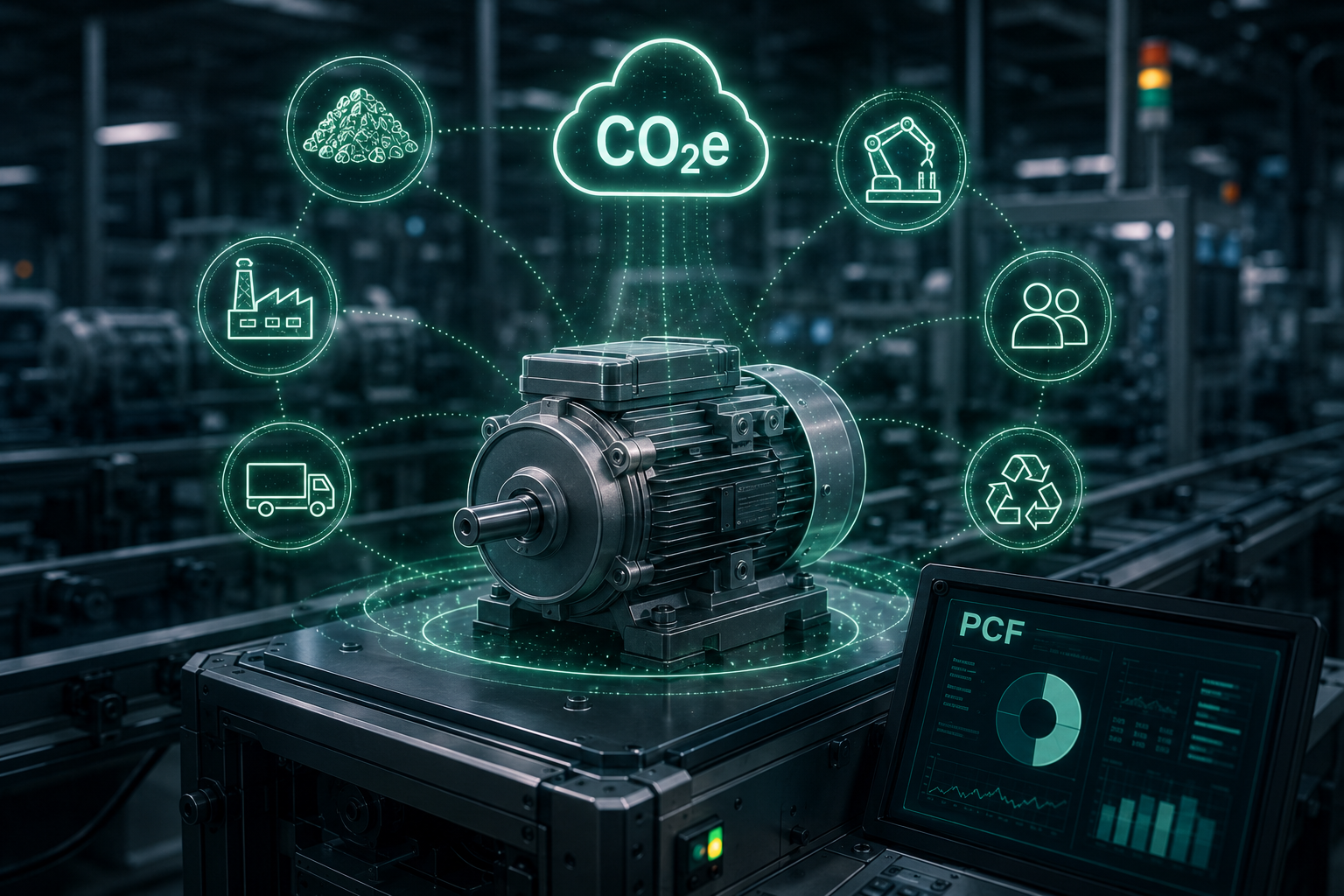
A product carbon footprint (PCF) is the total amount of greenhouse gas emissions caused by a product over a defined portion or all of its life. It is expressed in carbon dioxide equivalents (CO₂e), a single unit that converts the warming potential of different gases (methane, nitrous oxide, refrigerants, and others) into a common measure relative to CO₂.
The calculation is grounded in life cycle assessment (LCA), a methodology standardized by ISO 14040 and ISO 14044 and further specified for carbon by standards such as ISO 14067, the GHG Protocol Product Standard, and sector-specific rules known as Product Category Rules (PCRs). LCA asks a deceptively simple question: if you trace every input and output of energy, material, and process associated with a product, from the extraction of raw materials to the moment it leaves your factory gate or eventually reaches a landfill, what is the total climate impact?
The answer depends critically on two choices that every practitioner must make explicit.
System boundaries define which life cycle stages are included: A cradle-to-gate boundary covers raw material extraction, upstream processing, inbound logistics, and manufacturing — stopping at the point the product leaves the producer’s facility. This is the most common scope for business-to-business reporting, because it covers what a manufacturer can reasonably control and know. A cradle-to-grave boundary extends further: through distribution, the customer’s use phase, and eventually end-of-life disposal or recycling. Consumer goods, vehicles, and appliances often require this broader view because use-phase emissions can dwarf production emissions.
The functional unit defines what is being measured: one kilogram of steel, one circuit board, one vehicle kilometer driven, one kilowatt-hour of battery capacity delivered. The functional unit is not merely a bookkeeping detail. It is the basis on which products are compared, improvement is tracked, and claims are communicated. Changing the functional unit changes everything.
Why It Is Now Mandatory: CSRD, CBAN and Further Regulations
The shift from voluntary to mandatory carbon accounting for products and supply chains is being driven by three interlocking European regulatory frameworks. Together they create a situation where virtually any company that sells into or operates within the EU will need PCF data for its own reporting, for its customers’ reporting, or to clear a customs border.
The Corporate Sustainability Reporting Directive (CSRD)
The Corporate Sustainability Reporting Directive entered force in 2024 and is being phased in through 2028, eventually covering roughly 50,000 companies operating in the EU. The CSRD mandates corporate sustainability reporting under the European Sustainability Reporting Standards (ESRS). ESRS E1, the climate standard, requires companies to disclose Scope 1, 2, and — critically — Scope 3 greenhouse gas emissions. Scope 3 means supply chain: the emissions embedded in purchased goods and services, which for most manufacturers represent the majority of their climate impact.
This is where supply chain reporting becomes an inescapable obligation. A large automotive OEM subject to CSRD cannot report its Scope 3 Category 1 (purchased goods) emissions accurately without receiving PCF data from its tier-1 and tier-2 suppliers. The directive does not just affect large companies directly — it cascades through supply chains, creating de facto requirements for smaller manufacturers whose customers are covered entities. Climate disclosure is no longer a choice made in a corporate social responsibility team; it is an audited financial reporting obligation.
The Carbon Border Adjustment Mechanism (CBAM)
The Carbon Border Adjustment Mechanism is the EU’s tool for preventing carbon leakage — the risk that European manufacturers move production, or lose market share, to competitors in countries with weaker climate rules. CBAM places a carbon price on imports of certain goods — initially cement, aluminum, fertilizers, electricity, hydrogen, and iron and steel — based on the greenhouse gas emissions embedded in their production.
Importers must declare the embedded emissions in their goods and surrender CBAM certificates accordingly. As of 2026, CBAM is moving from its transitional reporting phase into full financial operation. For non-European manufacturers exporting to the EU, this is a direct financial incentive to calculate and reduce their product carbon footprint: the lower the embedded emissions, the lower the CBAM cost. For European manufacturers, it levels the playing field against lower-cost competitors who have historically externalized climate costs.
Downstream Customer Requirements
Beyond direct regulation, customer-driven regulatory compliance requirements are spreading rapidly. Automotive OEMs in the EU are operating under fleet-level CO₂ targets, making the PCF of every battery cell, aluminum casting, and polymer component commercially relevant. Electronics manufacturers face Ecodesign for Sustainable Products Regulation (ESPR) requirements that will include carbon labeling. Major retailers have committed to Science Based Targets and are pushing PCF data requirements down to their suppliers through procurement contracts.
The message for manufacturers is clear: whether you are mandated directly by CSRD, facing CBAM at the border, or responding to customer questionnaires, the ability to produce credible, standardized product carbon footprint data is becoming a basic cost of doing business in global manufacturing.
What is a Product Carbon Footprint (PCF)?
A product carbon footprint applies the same life cycle thinking as LCA, but focuses exclusively on one impact category: greenhouse gas emissions, expressed in CO₂ equivalents.
The product carbon footprint calculation follows standards such as ISO 14067 or the GHG Protocol Product Standard. It quantifies how many kilograms of CO₂ equivalents are associated with one unit of a product across its full life: from raw material extraction through the manufacturing process, distribution, use phase, and ultimately end of life, whether that means recycling or disposal.
The PCF is not a competing method, it is LCA applied with a narrower scope. Compared to an LCA, it offers a very targeted approach and data, delivers faster carbon insights for specific products or product categories and can be translated into feasible action for reducing emissions more easily.
Find out more about our ISO 14067 verified Product Carbon Footprint solution.
The Fundamental Inputs for a PCF Calculation
Understanding a PCF calculation requires understanding its four fundamental inputs: a bill of materials, activity data, emission factors, and the methods used to handle ambiguity and complexity.
The Bill of Materials as Carbon Map
Manufacturing starts with a bill of materials (BOM), the hierarchical list of every component, sub-assembly, and raw material that goes into a product. In PCF calculation, the BOM becomes the skeleton of the carbon model. Every line item represents an upstream emission source: the steel in a bracket, the copper in a wire harness, the resin in a housing. Software tools now read BOMs directly from ERP systems, automatically mapping each material to a corresponding emission factor and flagging gaps where data is missing.
Activity Data and Emission Factors
Activity data is the quantitative record of what actually happens: how many kilowatt-hours of electricity were consumed, how many liters of natural gas were burned, how many tonnes of aluminum were purchased, how many kilometers were driven by a logistics truck. Activity data comes from invoices, meter readings, production records, and logistics databases.
Emission factors translate activity data into CO₂e. They represent the greenhouse gas intensity of a specific activity: grams of CO₂e per kilowatt-hour of the local electricity grid, kilograms of CO₂e per kilogram of primary aluminum produced, grams of CO₂e per tonne-kilometer of road freight. Emission factors come from databases such as ecoinvent, the GHG Protocol’s emission factor repositories, national energy agencies, and increasingly from primary supplier data.
The quality of emission factors varies enormously. A generic industry-average factor for “aluminum” might be accurate to within a factor of two or three, because primary smelting powered by hydroelectricity in Norway and coal-fired smelting in China have vastly different emission intensities. This is why the drive toward primary, supplier-specific data is intensifying: a manufacturer that can show its aluminum comes from a low-carbon smelter has a competitive advantage, but only if it can prove it.
Allocation Methods
Most manufacturing processes produce more than one output. A steel mill makes multiple grades of steel. A chemical plant produces a main product and several by-products. A slaughterhouse processes an entire animal into dozens of products. When a process has multiple outputs, its environmental burdens must be divided among them — and the choice of allocation methods materially affects the result.
The main approaches are economic allocation (dividing burdens in proportion to the market value of each output), mass allocation (dividing by weight), energy allocation (dividing by energy content, common in refining), and system expansion (avoiding allocation by crediting the by-product for displacing an alternative). ISO 14067 and the GHG Protocol specify a hierarchy of preferred methods, but ambiguity remains significant, and the same product calculated by two practitioners using different allocation approaches can yield substantially different results. Harmonizing allocation methods within industry sectors — through PCRs — is one of the most important ongoing tasks in the field.
System Boundaries in Practice
Defining system boundaries sounds simple in theory but is complex in practice. Which upstream processes are included? At what point are capital goods (factory buildings, machinery) included in the analysis? How are logistics between facilities handled? What assumptions are made about energy sourcing? Every boundary decision affects the result, and inconsistent boundary definitions between suppliers make it impossible for customers to aggregate PCF data reliably.
This is why sector-specific standards and PCRs are so important: they pre-specify boundary decisions so that every producer in a sector is measuring the same thing the same way. The automotive industry, for example, has developed harmonized PCF methodologies for battery cells and vehicles specifically to enable consistent supply chain reporting.
Data Quality, Uncertainty, and the Path to Trust
A PCF is not a fact. It is an estimate, with uncertainty attached to every input. Data quality is the central challenge of carbon accounting, and it has multiple dimensions: temporal relevance (is the emission factor recent?), geographic specificity (does it reflect the actual location of production?), technological representativeness (does it match the actual process?), and completeness (are all relevant emissions included?).
Uncertainty analysis is the rigorous quantification of how much the final result could vary given the uncertainties in the inputs. Monte Carlo simulation is the standard approach: each uncertain parameter is assigned a probability distribution, and the model is run thousands of times to generate a distribution of possible outcomes. A PCF expressed as “12.4 ± 2.1 kg CO₂e” is more honest and more useful than a point estimate alone.
Transparency is what converts a number into a credible claim. A transparent PCF report documents the system boundary, the functional unit, all key data sources, the emission factors used, the allocation methods applied, the software or model used, and the key assumptions. Without this documentation, a PCF figure cannot be independently checked, compared, or improved over time.
Third-party verification is the external audit step that closes the loop. Verification bodies — accredited against ISO 14065 — review the methodology, check the calculations, and issue a statement that the PCF has been prepared in accordance with the stated standard. Verification is already required for CBAM declarations and is becoming standard practice for customer-facing PCF claims, both to satisfy regulatory requirements and to protect against greenwashing allegations.
How the Technology Has Evolved
Ten years ago, conducting a life cycle assessment was a months-long consulting exercise. A team of specialists would gather data manually, build a bespoke model in specialist LCA software (SimaPro, Sphera), and produce a PDF report that was outdated before it was finished. The cost was high, the repeatability was low, and the results were rarely integrated into operational decision-making. The evolution since then has been rapid and is still accelerating:
-
Phase 1 — Standardization of methodology. The GHG Protocol Product Standard (2011) and ISO 14067 (2018) established broadly accepted rules. Sector bodies began developing PCRs. This created the shared language without which comparison and aggregation were impossible
-
Phase 2 — Database maturation. LCA databases, above all ecoinvent, expanded in coverage and improved in quality. National and regional databases emerged. Sector-specific datasets were developed. The emission factor knowledge base became richer and more reliable.
-
Phase 3 — Software democratization. Dedicated PCF software platforms emerged alongside traditional LCA tools, designed for use by sustainability teams rather than LCA specialists. These tools offer BOM import, guided data collection, automated calculation, and reporting templates aligned to regulatory requirements. What once required specialist consultants can now be performed by trained internal teams.
-
Phase 4 — ERP and data integration. Modern PCF platforms integrate directly with SAP, Oracle, and other ERP systems, pulling BOM data, purchase quantities, and production volumes automatically. This eliminates manual data entry, reduces errors, and makes it feasible to calculate PCFs at product-variant level rather than product-family level.
-
Phase 5 — Supply chain data exchange. The most recent and consequential development is the emergence of standardized machine-readable PCF data exchange. Initiatives like the Catena-X automotive data ecosystem and the PACT (Partnership for Carbon Transparency) network enable suppliers to share PCF data directly with customers in structured, verified formats. Instead of filling out customer questionnaires, a supplier publishes a verified PCF to a shared data space, and the customer’s system reads it automatically.
- Phase 6 — AI-assisted data quality improvement. Artificial intelligence is beginning to assist with the most labor-intensive parts of the process: classifying spend data to emission categories, identifying the most appropriate emission factors for a given activity, flagging anomalies in reported data, and estimating missing primary data using pattern recognition from comparable processes. AI does not replace the methodological judgment required for rigorous PCF work, but it dramatically accelerates the data preparation and quality-checking steps.
The trajectory is clear: PCF calculation is moving from a periodic, expensive consulting exercise to a continuous, automated data product embedded in manufacturing operations.
PCF in Practice – a Decision-Making Tool
The manufacturers who are furthest ahead are treating the PCF not merely as a compliance output but as a decision-making tool. When embedded carbon is visible at product and component level, it changes procurement conversations: a buyer can see that switching to a supplier whose aluminum comes from a renewable-powered smelter reduces the product footprint by 15%, and can quantify what that is worth in CBAM savings and customer price premium. It changes R&D conversations: an engineer can see that redesigning a bracket to use 8% less steel saves more carbon than switching the entire factory to renewable electricity. It changes logistics conversations: a modal shift from air to sea freight becomes visible in the carbon ledger.
The manufacturers who are struggling are those who treat PCF as a form-filling exercise — gathering numbers to satisfy a customer questionnaire, with no underlying data infrastructure, no connection to operational data, and no intention of using the result for anything except compliance. This approach is becoming increasingly untenable: customers are getting more sophisticated in their data requirements, auditors are applying greater scrutiny, and the regulatory bar is rising.
Getting Started: A Practical Roadmap
For manufacturers who are early in their journey, the path forward has a logical sequence.
- Begin with scope and prioritization. Not every product needs a full cradle-to-grave LCA immediately. Start with the products that face the most customer or regulatory pressure, or those that represent the largest volume. A cradle-to-gate boundary is usually sufficient for B2B supply chain reporting and is where most demand currently sits.
- Build data infrastructure before you build calculations. The most common failure mode is investing in PCF software before the underlying data (BOMs, energy consumption records, supplier spend data) is organized and accessible. Connecting PCF workflows to existing ERP and energy management systems early avoids the creation of parallel manual processes.
- Adopt recognized standards from the start. Build to ISO 14067 or the GHG Protocol Product Standard and identify whether a sector-specific PCR exists for your product category. Using recognized standards is what makes your PCF credible to customers and auditors, and it is what regulators will require.
- Invest in primary supplier data progressively. Generic emission factors are acceptable to start, but they carry high uncertainty and will be scrutinized increasingly as standards tighten. Prioritize collecting primary data from the suppliers of your highest-impact materials first.
- Plan for verification. Even if third-party verification is not immediately required, designing your methodology and documentation to be verifiable from the outset is far easier than retrofitting it later.
Conclusion: It is Essential to Build a Product Carbon Footprint Capability
The product carbon footprint is becoming one of the most consequential numbers in manufacturing. It determines customs costs under CBAM, feeds mandatory disclosures under CSRD, satisfies customer procurement requirements, and increasingly drives the fundamental economics of how products are designed and sourced.
The underlying science is mature and well-standardized. The technology to apply that science at industrial scale, integrated with ERP systems and supply chain data exchange networks, is rapidly maturing. The expectation of transparency and third-party verification is solidifying into regulatory and commercial norms.
What has changed is not the science. What has changed is that the world has decided to use it. For manufacturers, the question is no longer whether to build a product carbon footprint capability, but how quickly and how well.